
-02.png)


CARBON REMOVAL
Carbon removal is the process by which humans actively and intentionally remove carbon dioxide (CO2) from the atmosphere and store it in longer-lived reservoirs.

Climate Lobbying
Climate lobbying refers to the act of influencing climate policy decisions, either directly through interacting with policymakers, or indirectly through influencing political campaigns, knowledge production, and media and communications.
How Does Lobbying Fit into the Legislative Process?
Lobbyists influence:
1.
Legislators’ drafting and passing of a new bill.
2.
Regulatory agent’s specification and enforcement of rules and regulations based on the bill.

Assistant Professor of Environmental Policy and Governance
Yale School of the Environment
Haewon Yoon
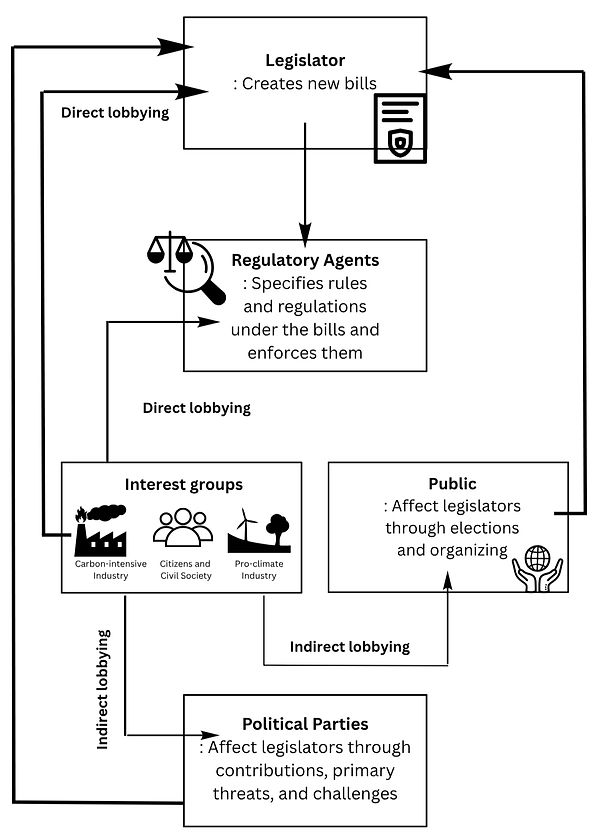
Interest groups such as carbon-intensive industry, citizens and civil society, and pro-climate industry engage with two types of lobbying: direct and indirect. Direct lobbying engages the legislative and the regulatory bodies of the government, while indirect lobbying engages political parties and the public, who then affects the legislators.
Strategies for lobbying legislators
1. DIRECT LOBBYING
Direct lobbying involves lobbyists meeting with the legislator to provide educational briefings and policy recommendations on a specific climate issue. Through this process, lobbyists can influence the legislator’s decision to either support or oppose a bill, as well as get involved with the drafting process to influence the content of the bill to align with their interests [1].
2. INDIRECT LOBBYING
Indirect lobbying involves lobbyists engaging party leaders or the public, who will then influence the legislators’ decision on a climate bill.
Lobbyists engage party leaders because the party system of the US allows for top-down pressure from party leadership and committees on individual legislators. Lobbyists may convince a party leader or a committee to leverage party resources such as political and financial support for the primaries, so that a legislator will vote for or against a certain bill. Additionally, because the party leaders control the agenda, lobbyists may convince party leaders to schedule a vote for the bill they support, or block it from appearing on the floor.
Lobbyists engage the public because they influence the legislators’ decisions through their voting power. Changing public attitude and opinion of a bill through media campaigns on social and news media, as well as public forums and town falls are some examples.
Strategies for lobbying regulators
1. DIRECT LOBBYING
Similar to direct lobbying of legislators through briefings and recommendations, direct lobbying of regulatory agency staff may involve technical briefings on the impact of a regulation on the lobbyists’ area of interest to influence the direction and scope of the regulation.
Often, former agency officials will become lobbyists and have an advantage of personal connections and understanding of the system, a phenomenon called a “revolving door”.
Another form of direct lobbying happens during the notice of proposed rulemaking stage (NPRM). When a regulatory agency makes changes to existing regulations or proposes new ones, they are required to notify and engage the public for comments through the process called NPRM [2]. It is in this stage that lobbyists submit technical, legal and public data supporting their position on the bill.
2. INDIRECT LOBBYING
Lobbyists may fund think tanks to publish reports that speak to the positive impacts of a set of regulations, which can then be used for direct lobbying or swaying public opinions and attitudes about them.
Who can participate in lobbying?
Who is currently lobbying?

Lobbying Amount by Actors: Oil & Gas vs. Environmental [a]
Strategies for lobbying legislators
1. DIRECT LOBBYING
Direct lobbying involves lobbyists meeting with the legislator to provide educational briefings and policy recommendations on a specific climate issue. Through this process, lobbyists can influence the legislator’s decision to either support or oppose a bill, as well as get involved with the drafting process to influence the content of the bill to align with their interests [1].
2. INDIRECT LOBBYING
Indirect lobbying involves lobbyists engaging party leaders or the public, who will then influence the legislators’ decision on a climate bill.
Lobbyists engage party leaders because the party system of the US allows for top-down pressure from party leadership and committees on individual legislators. Lobbyists may convince a party leader or a committee to leverage party resources such as political and financial support for the primaries, so that a legislator will vote for or against a certain bill. Additionally, because the party leaders control the agenda, lobbyists may convince party leaders to schedule a vote for the bill they support, or block it from appearing on the floor.
Lobbyists engage the public because they influence the legislators’ decisions through their voting power. Changing public attitude and opinion of a bill through media campaigns on social and news media, as well as public forums and town falls are some examples.
Strategies for lobbying regulators
Climate Lobbying in Action:
Meet Citizens’ Climate Lobby
“Citizens’ Climate Lobby is an international organization that trains and empowers everyday people to engage directly with their elected officials on climate solutions. Our volunteers are organized in chapters across the country in almost every congressional district. Our chapters work directly with their members of Congress on legislation related to carbon pricing, healthy forests, clean energy permitting reform, and building electrification and efficiency. We also work directly with state and local elected officials on those policy areas” [3].
Citizens’ Climate Lobby works in partnership with Yale Program on Climate Change Communication, whose resources such as the Yale Climate Opinion Maps inform CCL’s volunteer training.
Learn more (https://citizensclimatelobby.org/about-ccl/)
Footnotes
[1] Bloomberg Government. “Direct lobbying and government advocacy”. Bloomberg Government, 2025, https://about.bgov.com/insights/public-affairs-strategies/direct-lobbying-and-government-advocacy/
[2] "Notice of Proposed Rulemaking." Legal Information Institute, Cornell Law School, Accessed 5 Nov. 2025, www.law.cornell.edu/wex/notice_of_proposed_rulemaking.
[3] Simmons, Daisy. “13 tips for lobbying your elected officials about climate change” Yale Climate Connections, July 23 2023, https://climatecommunication.yale.edu/news-events/ypccc-partnerships-interview-with-citizens-climate-lobbys-tony-sirna/
[a]OpenSecrets. Climate change: Issue profile. https://www.opensecrets.org/news/issues/climate-change